
Montessori Curriculum Series Part 4 Mathematics: The Concrete Path to Abstract Understanding

Updated: Mar 21
This fourth installment dives into the captivating realm of Montessori Mathematics. Have you ever wondered how even our youngest learners, all the way up through elementary students, are able to master intricate concepts like place value, fractions, and even algebra? The core principle is straightforward: The Concrete-to-Abstract Path. This approach is the magic behind Montessori Math, transforming complex ideas into achievable lessons through a foundation in concrete materials before moving toward abstract understanding.

The Early Childhood (3-6) Foundation: Building Intuition
Dr. Montessori understood that a child's hand is the chief tool of the mind. That's why our math curriculum begins in the Early Childhood classroom with beautiful, tactile materials that lay the foundation for all future learning. Through manipulation, the child builds a deep, intuitive understanding of number and operation before the abstract symbols are introduced:
Number Rods: Introduce the concept of linear counting and the association of a quantity with its name, providing a concrete, proportional representation of the numbers 1 through 10.
Golden Beads: A concrete representation of the decimal system, allowing children to literally hold 'thousands' in their hands, forming the basis for place value and operations.
Strip Boards (Addition and Subtraction): Tools for memorizing addition facts (sums up to 18) and subtraction facts (minuends up to 18), providing a visual and physical way to explore number combinations.
The Elementary (6-12) Bridge: Mastering Abstraction
In the Elementary program, students use the foundation built in Early Childhood to transition seamlessly into abstract concepts. The materials continue to be used as tools for advanced work:
Stamp Game: A fun, engaging way to practice all four operations (addition, subtraction, multiplication, and division) with smaller, manageable quantities, introducing the mechanics of exchange (carrying/borrowing).
Bead Frames: A precursor to the abacus, building fluency and mental math skills in carrying and borrowing.
Checkerboard: Used for practicing large multiplication, offering a visual and structured method for solving complex problems.
Fraction Skittles: A material for advanced fraction operations, providing a hands-on way to explore challenging fraction concepts.
Benefits of Manipulatives in Elementary Education
This work leads to:
Mathematical Fluency: Moving from understanding how an operation works to achieving confidence and speed in mental and written computation.
Advanced Problem-Solving Skills: The ability to apply knowledge to multi-step, real-world scenarios, including geometry and measurement.
Conceptual Understanding of Higher Math: A natural introduction to concepts like algebra and geometry, seeing mathematics as an integrated system for understanding the world.
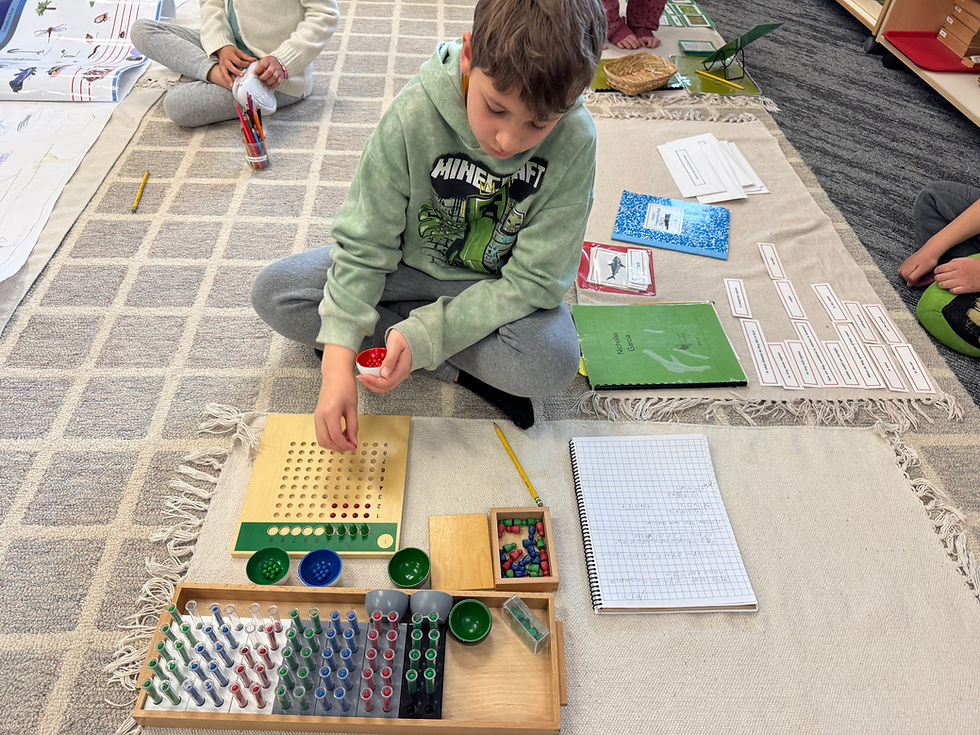
Building Analytical Minds: Montessori Math in Action. Montessori math is more than counting; it’s about making the abstract tangible and fostering a "math mind" that is analytical, logical, and confident. It’s the foundation for lifelong success in analytical thinking and problem-solving.
Coming next...
Stay tuned! The final post in the curriculum series is Cultural.


Comments